High Masculine Tones
a failure to communicate2.20.2002
Needcom: Market Research for Panhandlers

RATE six real panhandlers!
SEE, HEAR, and READ their panhandling pitches!
VOTE with your virtual wallet and compare your
GENEROSITY with the Web average!
Don't miss this exciting opportunity!!
...from the clever folks at Weblab.
2.19.2002
The mind is dealing with the world but is always working on itself. The mind takes materials from the world…
-- Robert J. Lifton
There are kinds of information, sometimes bare scraps and bits, that instantly arrange themselves into coherent, easily perceived patterns, and one either acknowledges those patterns, or one does not. For most of my adult life, I chose not to recognize those patterns, although they were the patterns of my own life as much as Wade’s. Once I chose to acknowledge them, however, they came rushing toward me, one after the other, until at last the story I am telling here presented itself to me in its entirety.
-- Russell Banks
We know more than we can use. Look at all this stuff I’ve got in my head: rockets and Venetian churches, David Bowie and Diderot, nuoc man and Big Macs, sunglasses and orgasms.
-- Susan Sontag
Chaos, Creation and Collage
...from the The Frank Olson Legacy Project
2.12.2002
The Religious Experience of Philip K. Dick by R. Crumb

For Dick, all facts must be dynamited free from the banal, oppressive systems which bind them, and put back into play. For this difficult task, paranoia comes in handy. "I'm out of step. I should yield to reality. I have never yielded to reality. That's what sf is all about," reads the preface to The Golden Man (1980) a collection of Dick's stories. The paranoid, like Mr. Tagomi in High Castle, takes nothing for granted, and knows that "We're blind moles. Creeping through the soil, feeling with our snoots. We know nothing."
Joshua Glenn, Hermenaut, Philip K. Dick (1928-1982)
2.07.2002
We see narrative everywhere. It's a primitive urge, a way to tie cause to effect, to convert the complexity of our experience to a story that makes sense.
. . . Narrative experience should grow naturally from the site's message and purpose. It's a mistake to invent narratives—human-faced "tour guides" to your site, for example—that don't flow naturally from the site itself.
The world abounds in stories. You don't need to invent: the story is already there. For a cause or a crusade, the story is the struggle. For a corporate site, the big story is the story of the company—its trials, its fortunes, the challenges it faces and the way it responds.
. . . Many sites today pretend to be about the reader. They imagine that the way to make an experience involving is to get readers to talk about themselves, to fill out questionnaires or polls or express their opinions on bulletin boards. But narrative takes us outside ourselves. We spend much of our existence thinking about ourselves, our problems, our feelings; drama takes us away from these daily worries.
Directly addressing the reader, peppering your audience with choices, surveys, and customization opportunities can increase the psychological distance between your message and your audience. Like a too-chummy, backslapping salesman, a website that asks too much also forces the audience to think about itself. The narrative experience shatters; and the reader, recalled to a host of deadlines and worries and errands, clicks elsewhere or switches off. Each of us is the hero of his or her personal dramas; sometimes, we want someone else to be the protagonist.
::Mark Bernstein, A List Apart: The Narrative Web: Beyond Usability and Design
2.04.2002
Werner Herzog Eats His Shoe (1979)

Gadfly interviews filmmaker Les Blank about his astonishing documentary featuring the German director.
There are two sides to the story of how this came about. Herzog claims he made a vow to eat his shoe if Errol Morris ever made a film that got shown at Berkeley. But Errol claims Herzog stole his idea when Herzog went to film those oddball people up in Wisconsin for his film Stroszek. Anyway, in the making of that movie, I saw how interesting he looked on film and that gave me the courage to go down to the Amazon [to film Burden of Dreams] with him and take my chances whatever may happen down there.
Can one really eat a shoe? Didn't Chaplin do that in The Gold Rush?
But that was a shoe made out of candy. Herzog really ate his shoe. Everything but the sole. He cut it up with poultry shears and he took it to be cooked in a Chinese restaurant to soften it up, but it ended up as tough as tempered steel. The idea being that if you cooked it in duck fat it would end up tender, but it had just the opposite effect.
It is with great restraint that I refrain from making a long Klaus Kinski posting right now. That won't last long.
::David Dalton, Gadfly: 'I just film': Interview with Les Blank
::Werner Herzog Film
::Flower Films: The Films of Les Blank
::Errol Morris
::Exploitation Retrospect's Online Guide to Klaus Kinski
Trying to define precisely what a blog is an exercise in futility, because blogs are constantly shifting, evolving and becoming something else. But, this seems to be the general consensus for the moment: blogs are personal websites, usually maintained by an individual, constantly updated with new information, personal experiences, analysis, hyperlinks and commentary on just about anything, to a repeat audience. [eLearning Post]
A tale of one man and his blog – London Guardian, Jan 31st 2002
The Connection Radio Interviews with some infamous weblogger types...
Invasion of the 'Blog': A Parallel Web of Personal Journals NY Times
weblogs: a history and perspective by Rebecca Blood
Meta-blogging? Intertwining Grassroots; Connecting the Blogging World from Mediageek
2002 Bloggies
2001 Bloggies
2001 Anti-Bloggies
Portals
Weblog Madness and FAQ's: Way too many links...
Webloggia
Tools
Blogger
GeekLog
Greymatter
Movable Type
Radio Userland
Spog
A profoundly inadequate selection of weblogs...
wood s lot
randomWalks
Riley Dog
Textism
Signal vs Noise
Scripting News
Media News
Acme Book Co.
Adnan
Caterina
Kuro5hin
The Morning News
Weblogs in education...
Chronicle of Higher Education Infotech
Chronicle of Higher Education Distance Ed
Teachnology
Education Week
eLearning Post
Dan Mitchell
Courses using weblogs
Stephen Downes is a supergenius, and is probably too preoccupied to hop aboard the weblog juggernaut. But maybe he should.
Perhaps the most adventurous version of the pedagogic potential of weblogs is presented by eLearning Post

. . . a strategy and technology so simple in design, that it could present the next wave of grassroots KM implementations. We are talking of the "storytelling" as the killer strategy, and "blogs" as the killer technology. Both of them share one common ground: grassroots interaction — a concept voiced by the likes of John Seely Brown, Larry Prusak, Steve Dennings, Dave Snowden, David Weinberger, among other prominent KM personalities.
Meta
Blogdex
Social Network Index
Daypop
Weblogs
Linkwatcher
Le Bloguer
Metafilter
Weblog Map
2.01.2002
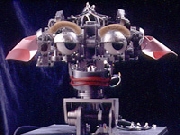
. . . an expressive anthropomorphic robot called Kismet that engages people in natural and expressive face-to-face interaction. Inspired by infant social development, psychology, ethology, and evolution, this work integrates theories and concepts from these diverse viewpoints to enable Kismet to enter into natural and intuitive social interaction with a human caregiver and to learn from them, reminiscent of parent-infant exchanges. To do this, Kismet perceives a variety of natural social cues from visual and auditory channels, and delivers social signals to the human caregiver through gaze direction, facial expression, body posture, and vocal babbles.
Kismet Home
Quicktime Video Clips [via lightningfield]
While we're in the neighborhood...
From McSweeney's: Warnings Affixed to Laboratory Doors at the Massachusets Institute of Technology
6. Do not have open containers of water in cold rooms: these cause excessive frost in the refrigeration system and lead to malfunction and temperature instability.
7. The contained atmosphere in environmental rooms and recirculation of most of the air creates a potential for retaining any aerosols that are formed during research procedures. This can lead to cross-contamination of research projects and personnel exposure. Keep these rooms as clean as possible.
Archives
12/01/2001 - 01/01/2002 01/01/2002 - 02/01/2002 02/01/2002 - 03/01/2002 03/01/2002 - 04/01/2002 05/01/2002 - 06/01/2002 09/01/2002 - 10/01/2002 11/01/2002 - 12/01/2002 12/01/2002 - 01/01/2003 01/01/2003 - 02/01/2003 02/01/2003 - 03/01/2003 03/01/2003 - 04/01/2003 04/01/2003 - 05/01/2003 05/01/2003 - 06/01/2003 06/01/2003 - 07/01/2003 07/01/2003 - 08/01/2003 08/01/2003 - 09/01/2003 09/01/2003 - 10/01/2003 10/01/2003 - 11/01/2003 11/01/2003 - 12/01/2003 12/01/2003 - 01/01/2004 01/01/2004 - 02/01/2004 02/01/2004 - 03/01/2004 03/01/2004 - 04/01/2004 04/01/2004 - 05/01/2004 05/01/2004 - 06/01/2004 06/01/2004 - 07/01/2004 07/01/2004 - 08/01/2004 08/01/2004 - 09/01/2004 10/01/2004 - 11/01/2004 11/01/2004 - 12/01/2004 01/01/2005 - 02/01/2005 02/01/2005 - 03/01/2005 03/01/2005 - 04/01/2005 04/01/2005 - 05/01/2005 08/01/2005 - 09/01/2005 09/01/2005 - 10/01/2005 11/01/2005 - 12/01/2005 12/01/2005 - 01/01/2006 02/01/2006 - 03/01/2006 03/01/2006 - 04/01/2006 12/01/2006 - 01/01/2007

Subscribe to Posts [Atom]